

Don't Miss the Next Commodity Rally: After Gold & Silver, Is This Commodity Setting Up for 2026?
Published on January 31, 2026
Every major market cycle has a familiar pattern. The biggest money is made before the crowd arrives, not after headlines confirm the move.
Gold and Silver have already delivered exceptional returns in the recent cycle. Silver, in particular, witnessed a sharp, extended rally that attracted widespread attention. But markets rarely reward those who arrive late. Historically, when commodities deliver such powerful upside moves, they tend to transition into distribution, consolidation, or time correction phases rather than continuing endlessly higher.
At this stage, the risk–reward equation in Gold and Silver has changed. And when that happens, capital doesn't exit commodities — it rotates.
When Leadership Changes, Money Follows
Commodity markets operate in rotational cycles. Once a leading asset matures, institutional capital begins searching for the next asymmetrical opportunity — assets that are still early in their trend lifecycle but show strong structural and technical alignment.
Right now, multiple signals suggest that Crude Oil could be positioning itself for that role in the next cycle. Not because of headlines. Not because of narratives. But because of structure.
Crude Oil: A Setup That's Still Early
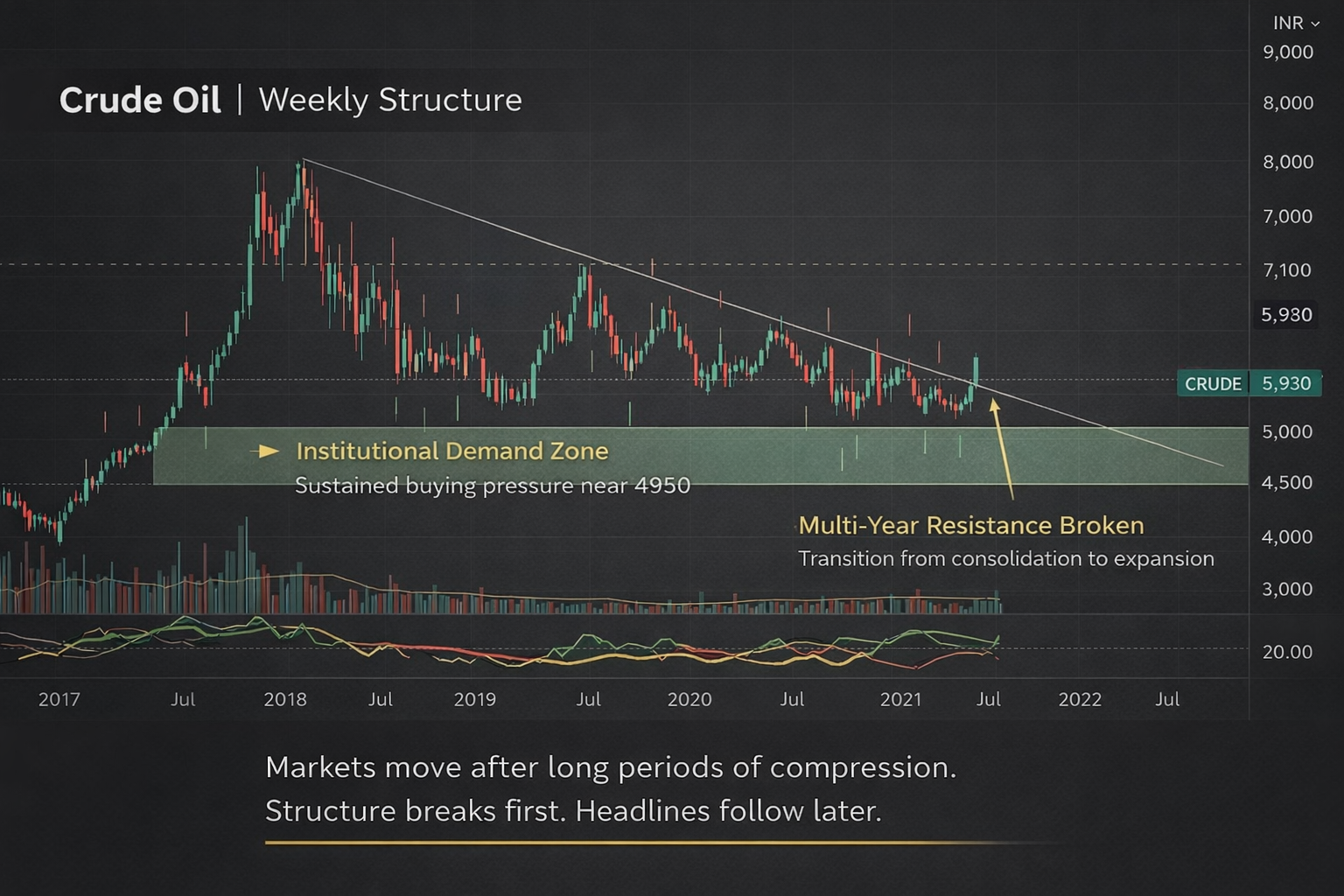
A Multi-Year Structural Breakout
Crude Oil has recently moved out of a long-term consolidation zone, breaking above resistance that capped prices for multiple years. Such breakouts, when sustained, often mark the transition from accumulation to expansion phases.
Markets spend more time consolidating than trending — and when they finally break, the moves tend to be directional and persistent.
Institutional Demand Zone Confirmation
Repeated price reactions near the 4950 region indicate a clearly defined demand zone. This area has acted as strong support, suggesting institutional accumulation rather than retail participation.
In professional market analysis, price holding above demand zones while volatility compresses often precedes trend acceleration.
Early Trend Signals Are Aligning
According to trend initiation models including the Inbestors Priority Trend Initiation framework, Crude Oil is approaching conditions that historically precede primary trend expansion.
Comparable signals in the past have appeared before major commodity rallies, including Silver's multi-fold advance earlier in the cycle. Markets don't ring bells at turning points. They leave footprints.
Elliott Wave Perspective: Entering the Expansion Phase
From an Elliott Wave standpoint, Crude Oil appears to be transitioning into Wave 3 — typically the strongest and most impulsive phase of any trend.
Wave 3 is where participation broadens, momentum expands, and price discovery accelerates. Most of the trend's total return is usually generated here — not at the top, but well before it becomes obvious.
A Trade Structure That Favors Asymmetry
From a risk–reward perspective, the setup remains attractive:
- Buy Zone: 5900 – 6000
- Invalidation Area: 5500
- Upside Potential: 8500 – 10,000
- Risk–Reward Profile: Approximately 1:5 to 1:8
This is the kind of structure professionals look for — limited downside exposure with meaningful upside expansion, not prediction-based optimism. As markets repeatedly demonstrate: you don't need to be right often — you need to be right big when you are.
The Bigger Picture
Gold and Silver have already done the heavy lifting in this cycle. Chasing extended trends often leads to poor positioning and emotional exits.
Crude Oil, on the other hand, is still early, structurally supported, and technically aligned across multiple frameworks.
The real opportunity isn't reacting once the move is obvious. It's positioning before it becomes consensus. Because by the time everyone agrees, the move is usually halfway done.
Disclaimer: This article is for educational and research purposes only. Commodity markets carry inherent risk. Please consult a qualified financial advisor before taking any investment decision.