Emergency fund and life cover: sort these before you invest
20 November 2026 · 10 min · Inbestors
Investing gets all the attention, but two quieter things protect everything else: an emergency fund and the right life cover. Here is how you can get both right.
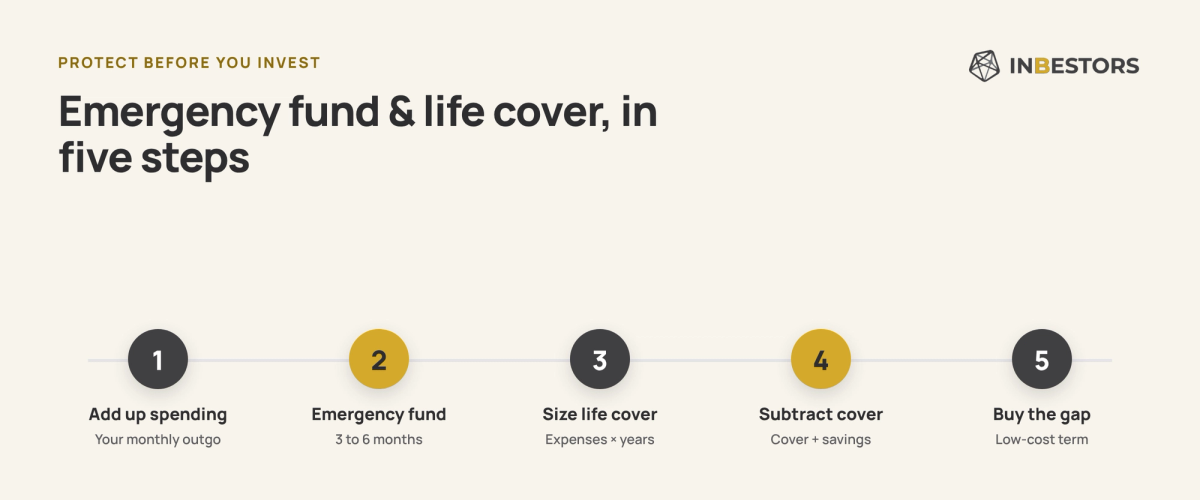
Most money advice jumps straight to investing: which fund, which portfolio, how much return. But before any of that, two quieter things protect everything you are building. An emergency fund, and the right amount of life cover. Get these two right and a single bad year, a job loss, an illness, something worse, cannot undo years of careful saving. Skip them, and your investments become the thing you are forced to break at the worst possible time.
Here is how to size both, simply.
New here? This is one piece of the bigger picture. Start with our complete guide, how to plan your finances, step by step, then come back for the protection step.
1. Start with what you spend each month
Both numbers are built on one figure: your real monthly spending. Add up everything your life costs in a normal month. Loan EMIs, rent or home upkeep, food and bills, travel, support for parents, children's fees, the rest. This single number drives both the emergency fund and the life cover, so it is worth getting roughly right.
2. Build your emergency fund first
An emergency fund is plain cash set aside for a shock: a job loss, a medical bill, a sudden repair. The rule of thumb is three to six months of your total monthly expenses. Three months is the floor. Six is comfortable, and more if your income is irregular or you are the only earner.
Two things matter as much as the amount. Keep it separate from your investments, so you are not tempted to dip in. And keep it somewhere you can reach in a day, like a savings account or a liquid or overnight fund, not locked away or sitting in equity where its value swings. This is the one pot that should be boring and always there.
3. Then work out your life cover
Life insurance does one job: if you are no longer around, it replaces your income so your family can carry on. You only need it if someone depends on you financially. If they do, the question is simply how much.
A good way to size it is needs-based. Take your family's yearly expenses and ask how many years they would need that income replaced, usually until the children are grown and independent. A young family might plan for fifteen to twenty years, an older one for ten. Multiply the yearly expenses by that span, and you have the cover your family's day-to-day life actually requires.
4. Cross-check against your income
There is a simpler rule many advisers use: cover of ten to fifteen times your annual income. It is quick, but it ignores your real expenses and what you already have. So use it as a sanity check, not the final word. Take the higher of the two numbers, the needs-based figure or ten times income, and that is a safe target to aim for.
5. Subtract what you already have, then buy the gap
You may already hold some cover through an employer policy or an old plan, and you may have savings earmarked for the family. Add those up and take them off the target. What is left is the extra cover to buy.
Buy it as term insurance. Term is pure cover with no investment mixed in, which makes it by far the cheapest way to buy a large sum. A healthy thirty-something can often cover a crore or more for the price of a monthly dinner out. Avoid plans that bundle insurance with investment; they tend to give you too little of both.
Want the exact number? Two forces move it
The steps above give a solid estimate. The precise figure depends on two things that pull against each other. Prices keep rising, so the expenses your family has to replace grow every year, which pushes the cover up. But the payout is not spent all at once. It sits invested and earns a return while the family draws from it, which pulls the cover down.
Most people add inflation and stop there, which overstates the number. You need both. And because a sensible return usually beats inflation, the precise figure often lands close to, or even a little below, the simple estimate, not above it. The exact method also replaces your income only for your remaining working years, from your age now to the age you would have retired.
You do not need to do this by hand. It is just worth knowing why a bigger, scarier number is not automatically the right one.
And then: review once a year
Your income, your family and your loans all change. A quick yearly check keeps both numbers right. As loans get paid off and savings grow, the cover you need usually falls; as your lifestyle rises, your emergency fund target rises with it.
See your own numbers in two minutes
You do not have to do any of this by hand. Our free Risk Planner works out both for you. Put in your monthly spending and income, and it shows the emergency fund to keep and the life cover your family would need, minus what you already have. Flip on the Precise toggle to factor in inflation, the return your payout would earn, and the years to your retirement.
Once your safety net is set, the rest of the plan can begin. Fund your life goals like a home, a car or a child’s education with the Goal Planner, and plan the long game with the Retirement Planner.
If you would rather talk it through, book a call with an advisor. We will start with protection, then build the plan around it.
Start where it makes sense for you
Join the Saturday webinar
Live, weekly. A ₹999 seat, for people serious about changing how they invest. No pitch.
Register ›Join the community
Market notes, webinar recaps, and questions answered on WhatsApp.
Join ›Talk to us
Prefer to ask first? Reach us on call, WhatsApp or email and we'll walk you through it.
Get in touch ›