How to plan for your retirement (the simple version)
19 November 2026 · 10 min · Inbestors
Retirement planning sounds complicated. It is really five simple steps: know what you spend, allow for rising prices, find your number, count what you have, and fill the gap with a monthly SIP.
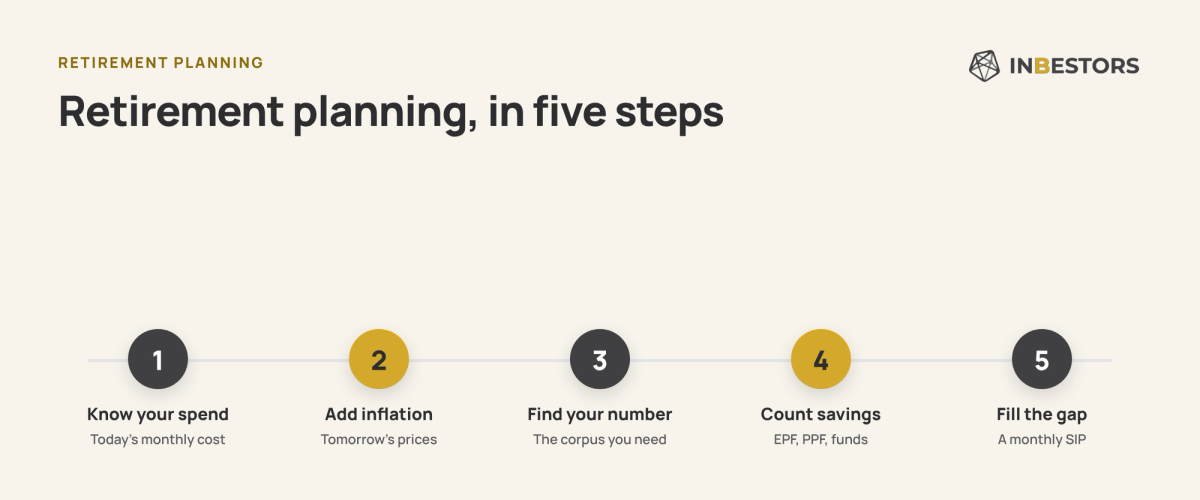
Most people put off planning for retirement because it feels complicated. It is not. Take away the jargon and it is just five simple steps. Here they are, in plain English.
New here? This fits inside the bigger picture. Start with our complete guide, how to plan your finances, step by step, then come back for the retirement step.
1. Know what you spend today
Start with your real monthly spending. Not your income, your spending: rent or home upkeep, food, bills, travel, the things your life actually costs each month. Leave out any loan EMIs that will be paid off before you retire. This number is the whole foundation, because retirement is really just about keeping this lifestyle going after the salary stops.
2. Allow for rising prices
What costs ₹60,000 a month today will cost a lot more in 25 years, because prices rise every year. That is inflation. A monthly expense of ₹60,000 today, growing at 6% a year, becomes around ₹2.5 lakh a month by the time you are 60. Planning with today's number is the most common mistake. Always plan with the future, inflated number.
3. Find your number (the corpus)
Your "corpus" is simply the lump sum you need on the day you retire, big enough to pay for your lifestyle for the rest of your life, and to leave behind anything you want to pass on. It has to cover expenses that keep rising with inflation, for all the years you expect to live, while the money itself keeps earning a modest, safer return. It sounds hard to work out, but a calculator does it in seconds (see below).
4. Count what you already have
Add up everything already set aside for retirement: mutual funds, EPF, PPF, NPS, anything earmarked for later life. That money keeps growing on its own until you retire. Whatever it grows to is a head start, and it comes straight off the corpus you need to build.
5. Fill the gap with a monthly SIP
The gap between the corpus you need and what your savings will grow to is what you still have to build. The simplest way to build it is a SIP, a fixed amount invested automatically every month. One useful trick: raise that amount a little every year as your income grows. A SIP that steps up 10% a year reaches the same goal with a much smaller starting amount than a flat one.
And then: review once a year
Life changes. Your salary, your spending, your goals all move over time. A quick once-a-year check keeps the plan honest, so you are never far off track.
See your own numbers in two minutes
You do not have to do any of this by hand. Our free Retirement Planner runs all five steps for you. Put in your age, your spending and what you have saved, and it shows the corpus you need and the exact monthly SIP to get there, with a year-by-year picture of how your money grows and then supports you.
Retirement is the long game, but it sits on a foundation. Make sure your safety net is in place first with the Risk Planner(emergency fund and life cover), and fund your nearer goals like a home or a child’s education with the Goal Planner.
If you would rather talk it through with a person, book a call with an advisor. We will build the plan around your real numbers.
Start where it makes sense for you
Join the Saturday webinar
Live, weekly. A ₹999 seat, for people serious about changing how they invest. No pitch.
Register ›Join the community
Market notes, webinar recaps, and questions answered on WhatsApp.
Join ›Talk to us
Prefer to ask first? Reach us on call, WhatsApp or email and we'll walk you through it.
Get in touch ›