How to plan for your money goals, step by step
20 November 2026 · 10 min · Inbestors
You don't have one financial future, you have several goals, each with its own cost, date and risk. Goal-based investing is the simple, repeatable way to fund them all. Here is the whole method.
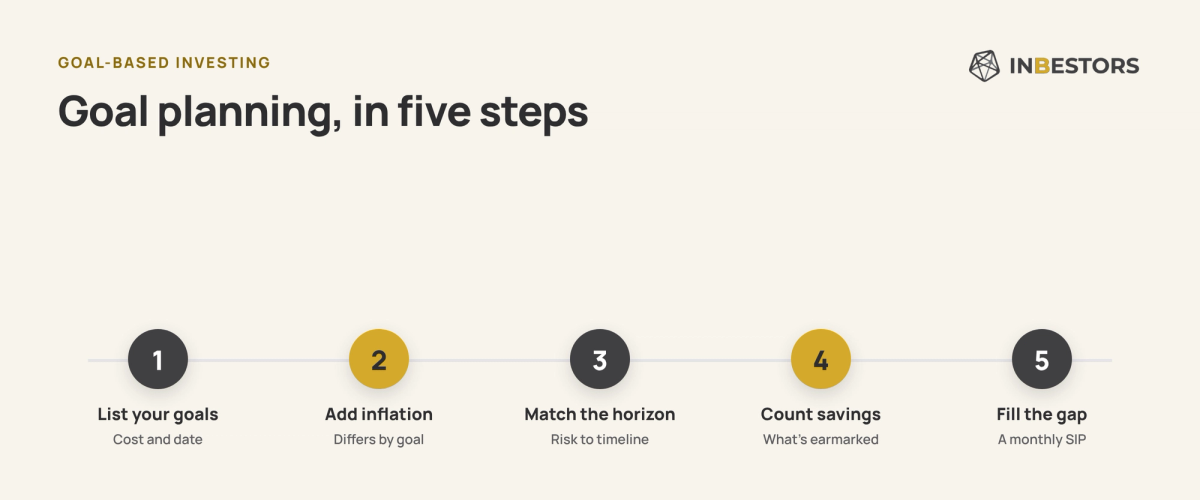
You do not have one financial future. You have a handful of real goals: a child's education, a home, a car, a long holiday, help for ageing parents. Each has its own price, its own date, and its own comfort with risk. Trying to fund them all from one vague pot is how goals quietly slip.
Goal-based investing fixes that. You plan each goal on its own, then fund them together. It is a simple, repeatable method, and it is the same one our Goal Planner runs for you. Here is the whole thing, step by step.
New here? This fits inside the bigger picture. Start with our complete guide, how to plan your finances, step by step, then come back for goal planning.
1. Write down every goal
Start with a list. For each goal note three things: what it is, when you will need the money, and what it would cost today. Do not guess the future price yet, just today's price. "A car in 4 years, ₹12 lakh." "My daughter's college in 12 years, ₹25 lakh in today's fees." Getting it out of your head and onto a list is half the work.
2. Add inflation, and remember it differs by goal
Prices rise every year, so a goal always costs more by the time it arrives. That is inflation, and this is the step most people skip. Worse, inflation is not the same for every goal. College fees in India rise far faster than a car's price. An education abroad adds the rupee weakening on top.
As a rough guide: education in India around 10% a year, education abroad around 13%, a wedding around 8%, a home around 7%, a car around 5%. Apply the right rate and the numbers get real. That ₹25 lakh college goal, growing at 10% for 12 years, becomes about ₹78 lakh. Plan for ₹78 lakh, not ₹25 lakh.
3. Match the time horizon to how you invest
How you invest a goal's money should depend on how soon you need it, because that decides whether you can wait out a market fall.
Long goals, more than seven years away, can lean into equity for higher growth, because there is time to recover from the dips along the way. A balanced return of around 12% is reasonable to plan with. Medium goals, three to seven years, sit in a mix of equity and debt, around 9%. Short goals, under three years, belong in debt or liquid funds, around 7%, where the money barely moves. You cannot afford a crash landing right before you spend.
4. Count what you have already set aside
For each goal, add up what is already earmarked for it: existing mutual funds, deposits, anything you have mentally tagged to that goal. That money keeps growing until the goal arrives, so it is a head start. Whatever it grows to comes straight off what you still have to build.
5. Fill each gap with a monthly SIP
The gap between what the goal will cost and what your earmarked money will grow to is what you still need to build. The simplest way to build it is a SIP, a fixed amount invested automatically every month. One habit makes it much easier: step the SIP up a little every year as your income grows. A SIP that rises 10% a year reaches the same goal with a noticeably smaller starting amount than a flat one.
6. If you cannot fund everything, prioritise
Add up the SIPs for all your goals. If the total is more than you can invest right now, do not abandon the plan, rank it. Fund the nearest and most important goals first, and give the others smaller SIPs or a later start. A part-funded plan you actually follow beats a perfect plan you cannot afford. As your income grows, raise the SIPs and bring the lower goals back up to speed.
7. Review once a year, and de-risk near the end
Life moves. Incomes rise, costs change, new goals appear. A quick once-a-year review keeps the plan honest. And as any goal comes within about three years, start shifting its money from equity into debt, so a bad market in the final stretch cannot derail something you are about to spend.
See your whole plan in two minutes
You do not have to do any of this by hand. Our free Goal Planner runs all of it at once. Add your goals, and it shows each one’s future cost, the monthly SIP to fund it, a suggested equity-debt split, and a timeline of everything together. Put in a monthly budget and it even tells you which goals fit and helps you prioritise the rest.
Two things sit outside this. Before funding goals, check your safety net with the Risk Planner, your emergency fund and life cover. And retirement works differently, with income to replace rather than a one-time cost, so it has a dedicated Retirement Planner.
If you would rather talk it through, book a call with an advisor. We will turn your list into a real plan.
Start where it makes sense for you
Join the Saturday webinar
Live, weekly. A ₹999 seat, for people serious about changing how they invest. No pitch.
Register ›Join the community
Market notes, webinar recaps, and questions answered on WhatsApp.
Join ›Talk to us
Prefer to ask first? Reach us on call, WhatsApp or email and we'll walk you through it.
Get in touch ›