

Markets often move in cycles. At any given time, some sectors remain muted while others quietly gather strength. The real challenge for investors is not identifying movement after it has already happened, but recognising where strength is building before it becomes obvious.
Ashapura Minechem offers a useful example of how stock-level outperformance can emerge even when broader markets remain flat — provided the selection is guided by structure, data, and discipline rather than short-term speculation.
The Market Context
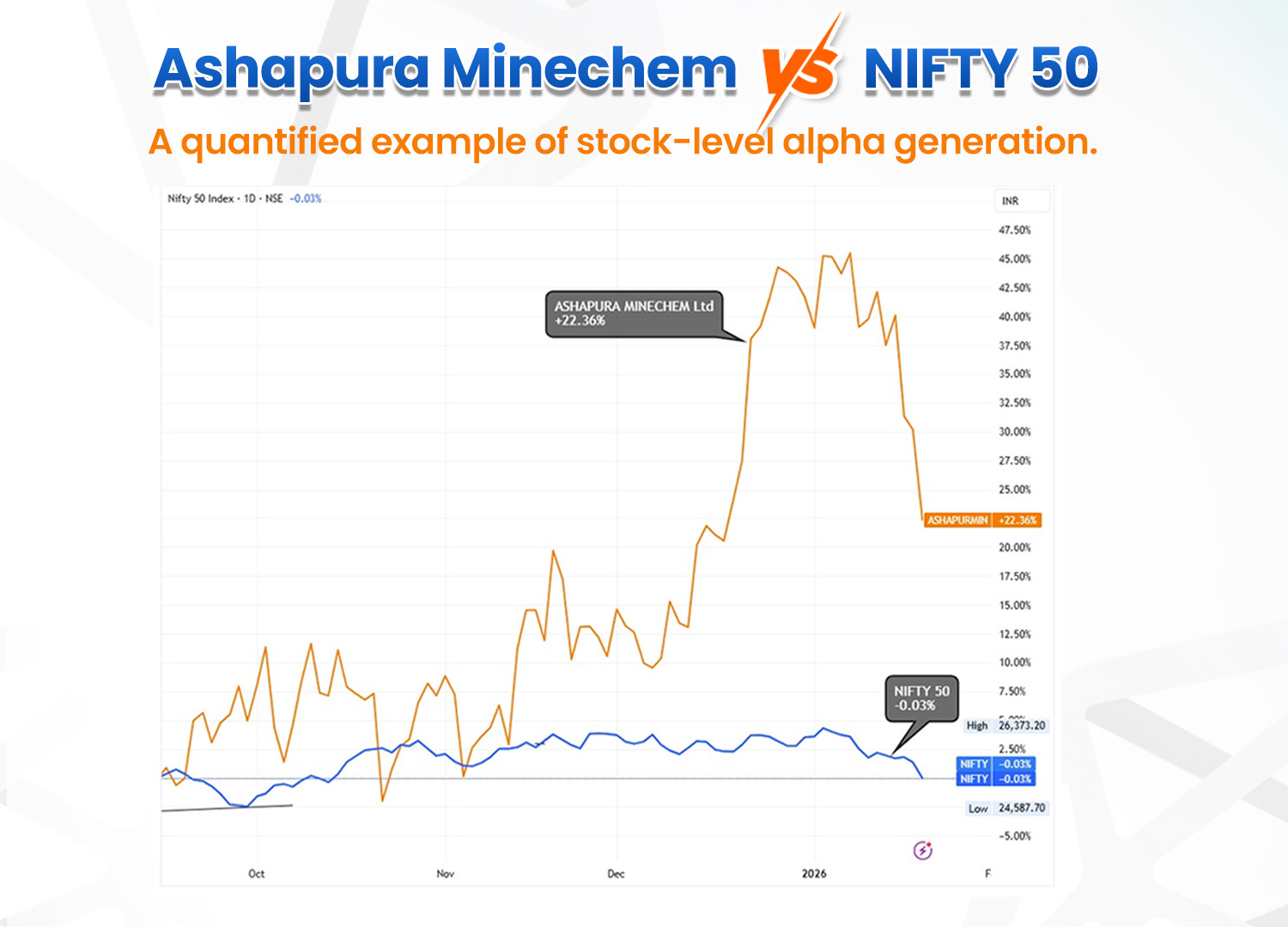
During a roughly two-month period, the broader market showed limited direction. The Nifty 50 remained negative and delivered -1% during the same period, reflecting a phase of consolidation rather than expansion. In such environments, broad index exposure rarely delivers meaningful returns. However, select stocks can still generate alpha when supported by sector strength, internal fundamentals, and favourable price behaviour.
Ashapura Minechem delivered approximately +23% during this period - a clear divergence from the benchmark. This was not the result of a sudden news event or market-wide rally, but a structured setup that had been forming over time.
Understanding Relative Strength
One of the first signals came from relative strength. Relative strength compares how a sector or stock is performing against the broader market. When a sector consistently outperforms the benchmark, it indicates that capital is flowing toward that space - often ahead of wider recognition.
At the time of selection, the mining and metals sector was outperforming the broader market. Ashapura Minechem demonstrated sustained strength within this sector, maintaining performance even when indices lacked momentum. This relative strength suggested that the stock was not moving in isolation, but as part of a sectoral trend backed by demand.
Relative strength does not predict future prices, but it helps identify where the market is already voting with capital. This makes it a powerful tool when used alongside other confirmation signals.
Confidence Reflected Through Promoter Activity
Another important layer was the confidence of promoters in the business. Over several years, promoter ownership in Ashapura Minechem increased materially - from approximately 39% to 47%. Such consistent stake increases typically indicate long-term belief in the company's prospects.
Promoter buying does not guarantee future performance, but it often reflects alignment between management and shareholders. When those closest to the business continue to commit capital, it strengthens the fundamental case and reduces uncertainty around intent.
Why Market Capitalisation Matters
Market capitalisation plays a critical role in stock behaviour. Extremely small companies often lack liquidity and stability, while very large companies may struggle to deliver outsized growth.
Ashapura Minechem was positioned around a ₹6,000 crore market capitalisation, a zone that often offers a balance between institutional visibility and growth potential. Companies in this range are large enough to attract serious capital, yet still agile enough for meaningful price expansion as fundamentals improve.
This positioning allowed price movements to be supported by volume rather than thin liquidity, making the trend more sustainable.
Price and Volume: The Final Confirmation
In Ashapura Minechem's case, rising prices were accompanied by visible volume accumulation. This indicated participation rather than speculation. The stock maintained strength above key levels, suggesting that buyers were willing to hold positions rather than exit quickly.
When price and volume move together, it reflects conviction. This alignment often separates durable trends from short-lived spikes.
Why This Was a High-Conviction, Quant-Backed Setup
This setup qualified as high conviction because several measurable factors aligned simultaneously. The mining and metals sector was showing clear relative strength against the broader market, indicating active capital inflows. Within this environment, Ashapura Minechem displayed sustained price strength, confirming participation in the sector trend rather than isolated movement.
Alongside this, promoters steadily increased their stake over time, reflecting long-term confidence in the business. The company's positioning around a ₹6,000 crore market capitalisation allowed room for growth while remaining visible to institutional investors. Price advances were further supported by volume accumulation, suggesting conviction-driven participation. Together, these signals created a quant-backed framework focused on risk reward clarity rather than prediction.
The Larger Lesson
Ashapura Minechem's performance highlights an important investing truth that markets do not always reward broad exposure, but they often reward selective strength. Stock-level alpha emerges when structural factors align, even during periods of index stagnation.
This case study reflects the type of analytical framework applied within Infinity10 by Inbestors, where quant signals, fundamental alignment, and market structure are combined to identify opportunities early.
Shared for research and learning purposes, this example illustrates how disciplined analysis can help investors understand why a stock moves, not just that it moved.
Stock-level alpha emerges when structural factors align. Through disciplined analysis combining relative strength, promoter confidence, market positioning, and volume confirmation, investors can identify opportunities before they become obvious to the broader market.